
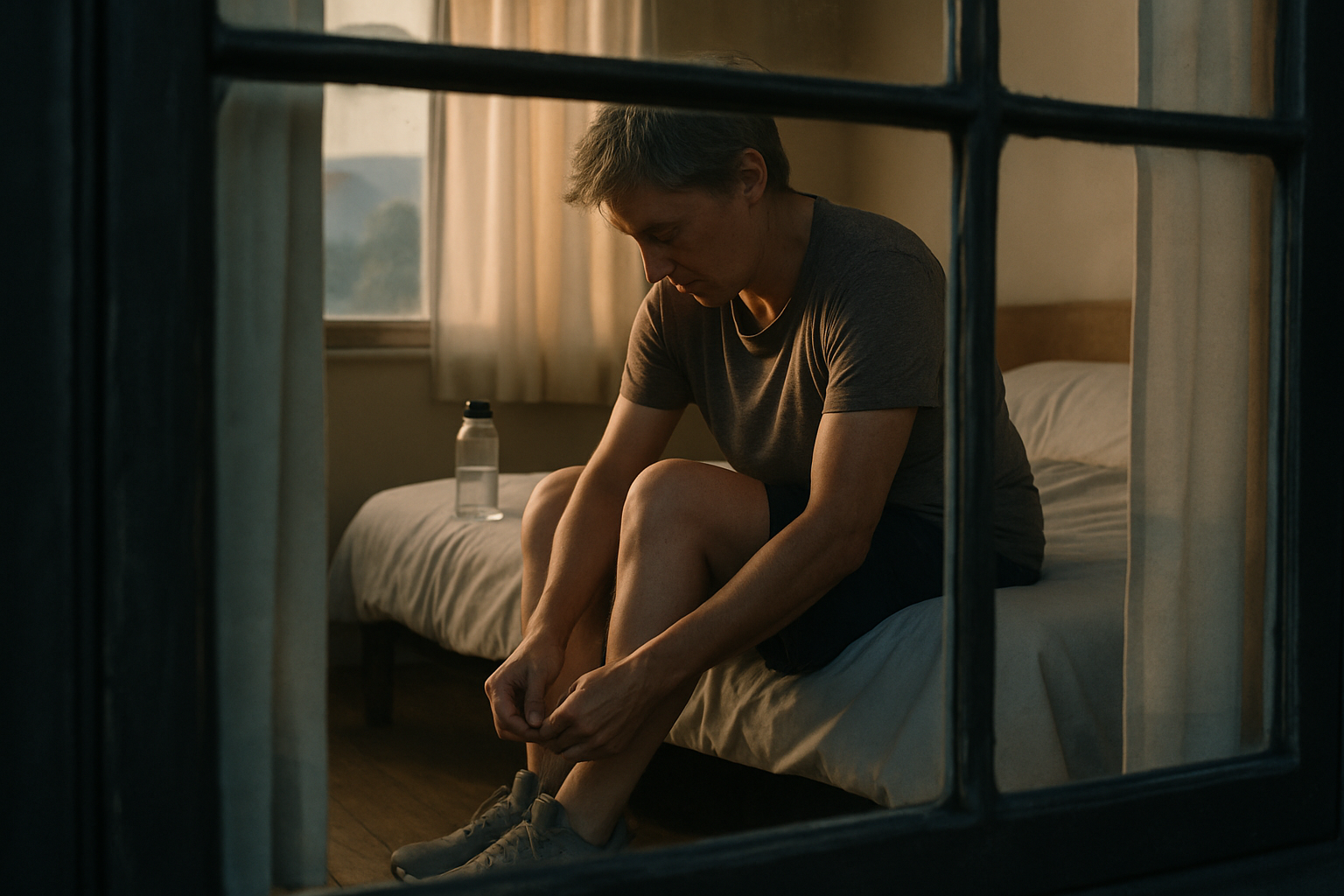
You decide to sort your health out. You start training, drinking more water, going to bed earlier. And within a few days you feel worse, not better. You ache. You are tired. You are up in the night needing the loo. So you quietly conclude it is not working, and you drift back to how things were.
BLUF: Change usually feels worst before it feels normal, and the early discomfort is not proof the new behaviour is wrong. It is the friction before your body and your routine adapt.
The idea most people get wrong
There is a common belief that a good change should feel good straight away. That if the new habit was right for you, it would slot in smoothly and you would feel better within the week.
So, firstly I would say... that is rarely how it works. And judging a new behaviour by its first few days, or even weeks, is one of the fastest ways to talk yourself out of it.
Your body and your daily life are both built around what you have repeatedly done. Change the inputs, and you get short-term disruption before you get a new baseline. That disruption is not a warning sign. It is the process.
Homeostasis, but let's not overclaim it
The easy way to explain this is homeostasis: the body's tendency to keep its internal state stable. It is a real and useful idea, but I want to be honest that it is a starting point, not a complete explanation.
Your body does not "want" you to stay unfit, dehydrated or sleep-deprived. That would be a bit dramatic. What actually happens is that different systems respond to change in different ways, and several of those responses feel uncomfortable at first.
Researchers often extend this idea with a related concept called allostasis, which describes how the body adjusts its set points in response to repeated demands rather than defending a single fixed state.
The practical point is simple: repeated inputs shift what your body treats as normal. Abrupt ones just create friction on the way there.
Why the early discomfort happens
Let's take the three big ones, because the mechanisms are genuinely different, and understanding them helps you stop misreading them.
Training: the aches and the tiredness
When you increase your training, especially with movements your body is not used to, you get delayed-onset muscle soreness. It typically shows up 24 to 72 hours later and eases as your body adapts to that type of loading. This is a well-described response to unaccustomed exercise, and it reduces with repeated exposure (review on exercise-induced muscle damage, PMC).
So what that means is: the soreness in week one is not a sign you have injured yourself or picked the wrong plan. It is a sign your body is being asked to do something new. Repeat it sensibly and it settles.
The fatigue is similar. You are adding a demand your body has not been managing. Give it consistent, manageable exposure and recovery, and your capacity grows.
Hydration: the extra trips to the loo
Start drinking more water and, yes, you will need the toilet more often. Your kidneys regulate fluid balance, and when intake goes up quickly, output goes up too until your body settles into handling the new volume.
That extra inconvenience early on is easy to read as "this is a faff, it is not worth it". It is not evidence the habit is wrong. It is just your regulation catching up with the change.
Sleep: why more time in bed does not instantly mean more sleep
This one frustrates people the most. You decide to prioritise sleep, you get into bed earlier, and you lie there wide awake. So you assume you "just can't sleep".
Sleep is driven by two things: sleep pressure, which builds the longer you are awake, and your circadian rhythm, your internal body clock. If you suddenly give yourself an extra ninety minutes in bed, you have not necessarily built enough sleep pressure at that new time, and your body clock is still set to the old pattern (overview of the two-process model of sleep regulation, PMC).
So what that means is: better sleep is often about consistent timing and daytime habits, not just more hours in bed on night one. It shifts gradually, not overnight.
And then there is the habit itself
On top of all the physiology, there is the simple fact that a new behaviour feels effortful until it becomes automatic. There is no magic number, but the often-quoted "21 days" is a myth. One well-known study found habits took a median of around 66 days to become automatic, with a wide range depending on the person and the behaviour (Lally et al., European Journal of Social Psychology).
The key takeaway: repetition is what turns effort into normal. Most people never give it long enough to find that out.
Why most people quit at exactly the wrong moment
Here is the pattern I see. Someone changes everything at once. Training, water, sleep, food, the lot. They feel sore, tired, disrupted and a bit rubbish. They conclude it is "all too hard", and they stop.
They quit right at the point where their body was starting to adapt. They mistook the friction for a verdict.
As we all know, the plan that felt impossible in week one usually feels ordinary by week six. But only if you are still doing it in week six.
How to get through the friction
You do not push through by gritting your teeth harder. You get through by making the change small enough to survive its own awkward beginning.
Here's what to do:
- Don't judge a new habit by its first few days. Give it weeks, not days, before you decide anything.
- Change one thing at a time where you can. Stacking five new demands multiplies the friction and the reasons to quit.
- Make it manageable enough to repeat. A change you can do on a busy Tuesday beats a perfect plan you abandon by Friday.
- Expect the specific discomfort. Sore from training, more loo trips from water, restless the first few nights of earlier bedtimes. Name it in advance and it loses its power to derail you.
- Fix the timing, not just the amount. Especially with sleep. Consistent wake and sleep times do more than one big early night.
Because... better to be consistently good, than sporadically great.
The bit worth staying for
Once these things become familiar, the benefits stop feeling like a battle and start feeling like your baseline. More energy. A steadier mood. Feeling more present with the people around you. Consistent exercise, decent hydration and better sleep are all repeatedly linked with improved subjective wellbeing, though I would say honestly that the gains build over time rather than arriving in a dramatic flash.
And here is the part I like most. Once the better version becomes your normal, you notice when you slip away from it. You will slip, by the way. Everyone does. But instead of quietly sliding back with no alarm going off, you feel the difference. You feel flatter, more tired, less sharp. That feeling is a nudge, telling you to get back to the things that make you feel good.
That is the real shift. Not a set of numbers, but a new normal that lets you feel when you have drifted from it.
The key message here is: your body resists change until it becomes the new normal, and the only way past the resistance is to keep going long enough to reach the other side.
If you have any questions, queries or concerns about where to start, don't sit on them, let me know.