
"How many carbs an hour do I need?" is the question people ask. What usually brings them to it is a story that goes like this.
The swim was fine. The bike felt strong, maybe a bit too strong. Then somewhere around 8km into the run, the lights went out.
Almost every time, that is a fuelling problem. And almost every time, the mistake was made hours earlier, on the bike.
BLUF: for anything over about two hours, aim for 60 to 90g of carbohydrate an hour, and practise it long before race day. Your gut needs training just like your legs do.
Why you run out
Your body stores a limited amount of carbohydrate, roughly enough for 90 minutes to 2 hours of hard work. Fat stores are effectively unlimited, but fat cannot be burned fast enough to hold race pace on its own.
So, what that means is: past two hours, your race becomes a fuelling event as much as a fitness event. Carbohydrate availability is one of the most important factors in endurance performance for anything lasting beyond about 90 minutes.
The numbers, honestly
Here is the working range most of the evidence points to:
- Under 1 hour: little or nothing needed. Water is usually fine.
- 1 to 2 hours: around 30 to 60g an hour.
- 2 hours and beyond: 60 to 90g an hour.
- Long full-distance days, gut trained: some athletes push toward 100 to 120g an hour.
Those bands come from established sports nutrition guidance, and the practical picture is consistent: without gut training most people manage around 60g an hour comfortably, and with consistent practice many get to 90g with few stomach problems.
The bit that makes 90g possible
There is a genuine piece of physiology worth knowing here, and it is the reason modern gels taste the way they do.
Glucose is absorbed through one set of transporters in your gut. Fructose uses a different route. Because they do not compete, using both together lets you absorb more carbohydrate per hour than glucose alone can manage.
For example: a roughly 2:1 glucose to fructose blend is what allows intakes up to about 90g an hour, and research has shown meaningfully higher carbohydrate oxidation rates than glucose-only drinks.
The key takeaway is: above about 60g an hour, the type of carbohydrate starts to matter as much as the amount. Check the label for a glucose and fructose blend, or a maltodextrin and fructose one.
Train your gut, not just your legs
This is the step almost everyone skips. Your gut adapts to what you regularly ask of it, and it adapts reasonably quickly, but it will not do it for the first time on race morning.
Here's what to do:
- Start where you are. If you currently take one gel on a long ride, that is your baseline. Do not jump straight to 90g.
- Add about 10g an hour every week or two on your long sessions, until you reach your target.
- Rehearse race day exactly. Same products, same timings, same bottles. Long bricks are the best place to test it.
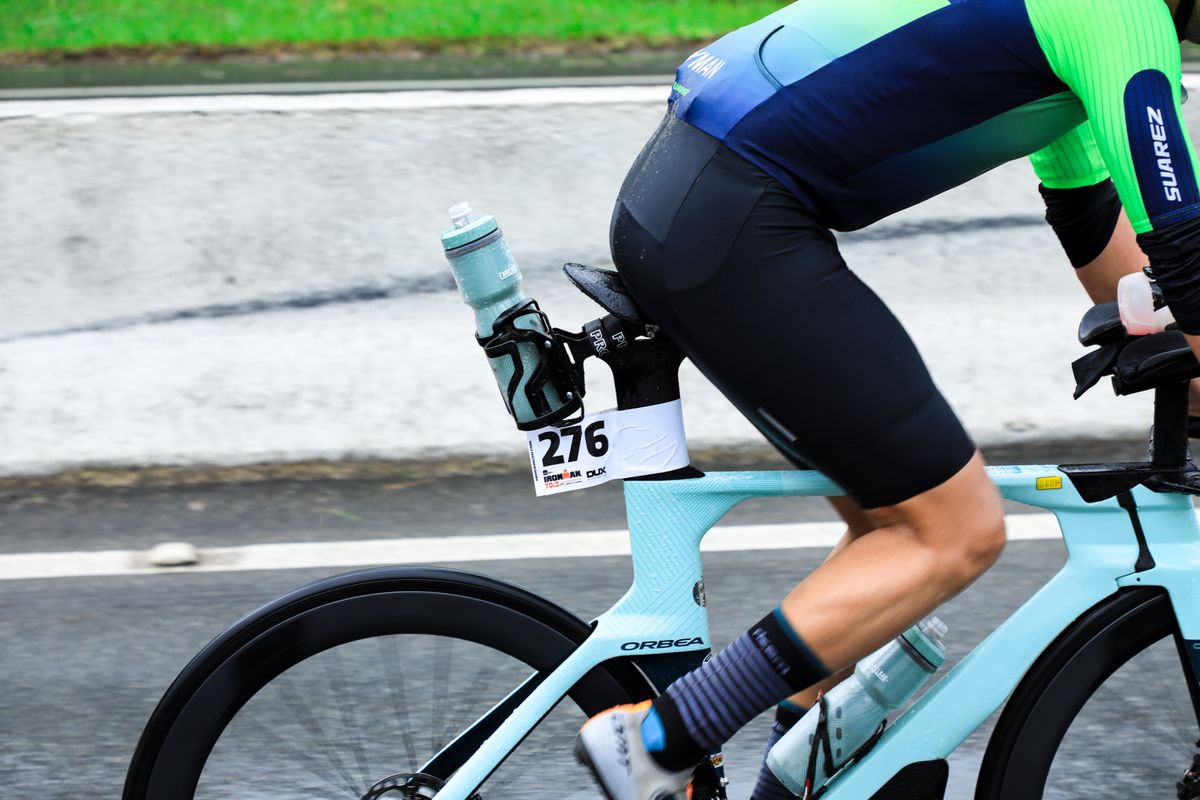
- Front-load the bike. It is far easier to eat on the bike than on the run, so take the bulk of your carbohydrate there. That is the single biggest change most first-timers need.
- Use what is on course, or carry your own. Check the race's own aid station list. If you do not get on with what they hand out, plan to carry it.
Do not forget fluid and sodium
Carbohydrate gets the attention, but dehydration and sodium losses will end your day just as effectively.
As a general starting point, 500 to 900ml of fluid an hour depending on heat and body size, with 500 to 1,000mg of sodium per litre. Sweat rates vary enormously between people, so treat those as a starting point and refine them from experience.
Try this: weigh yourself before and after a long session in similar conditions. Every kilo lost is roughly a litre of fluid you did not replace.
Put a number on your own race
If you want this worked out for your body weight, your race duration and the conditions on the day, our Race Nutrition Planner builds an hour-by-hour plan with carbohydrate, fluid and sodium targets, and translates it into real products.
Every one of our race guides can also build the fuelling plan alongside your predicted splits, which is useful because your fuelling needs depend on how long you are actually out there.
The bottom line
Most people do not blow up on the run because they lacked run fitness. They blow up because they under-ate on the bike.
Get to 60g an hour first. Build toward 90 if the day is long. Practise all of it, so that on race day you are repeating something familiar rather than gambling.
If you are unsure where to start with your own fuelling, don't sit on it, let me know.