
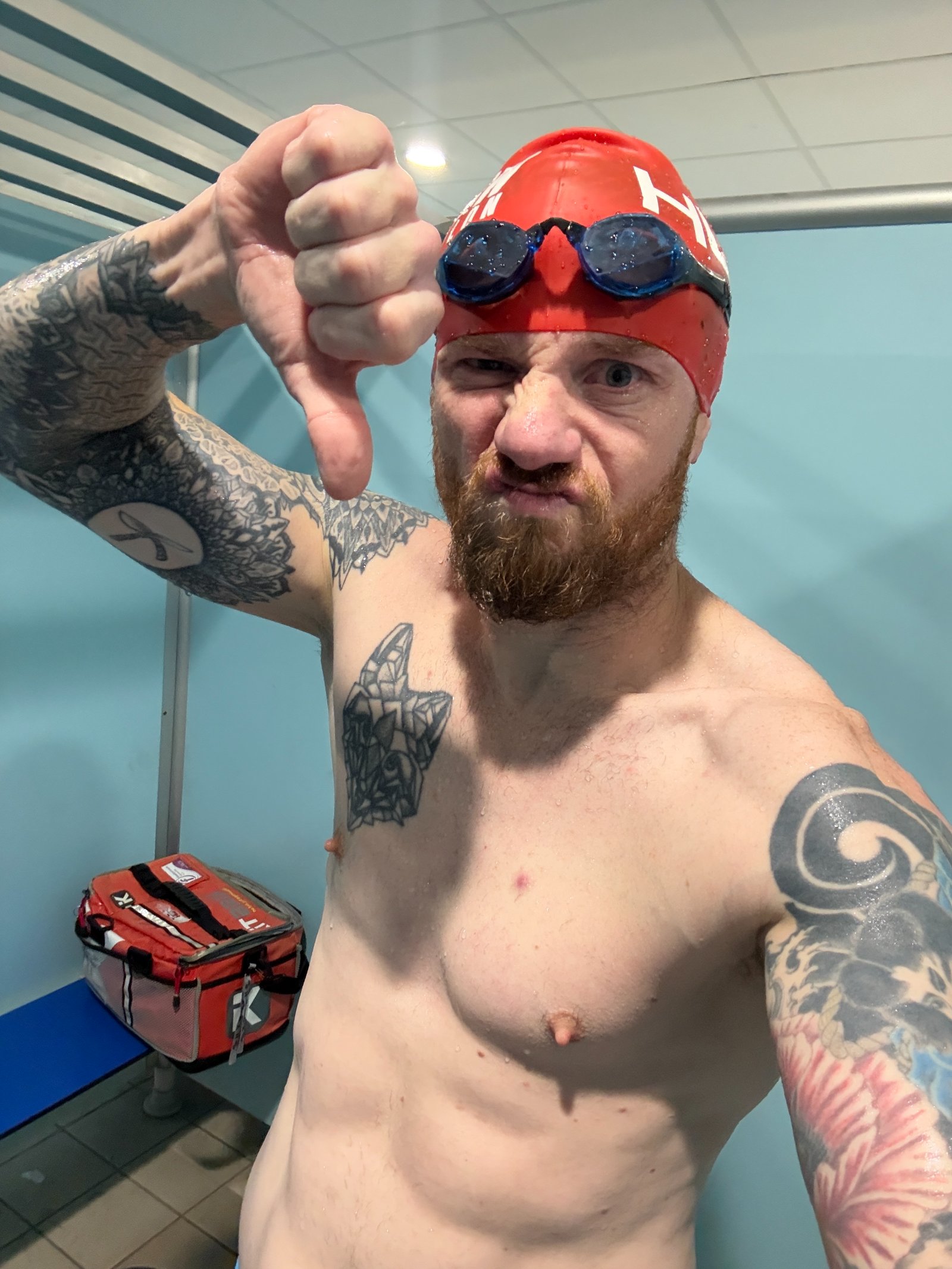
I knew before I left the house that I was not going to finish my swim today. My son's school bus was late, then I hit traffic coming into town, and the pool I use has restricted lane-swim times. The window kept shrinking. So why did I still get in?
BLUF: When life cuts your swim short, an adapted, purposeful session is almost always worth more than skipping it altogether. Protect the practice where you reasonably can.
The swim I nearly skipped
Here is how the morning actually went. I got my son ready, waited on a bus that turned up late, then crawled into town behind the usual traffic. The clock was ticking the whole way.
I was heading to the gym afterwards anyway. So the easy option was right there in front of me: go straight to the gym, skip the pool, and tell myself, "Well, I can't do the whole swim now, so what's the point?"
It is a very tidy little excuse. It even sounds sensible. But it rests on a flawed assumption: that a session only counts if you finish all of it.
That being said, with swimming there is a second reason I did not want to skip it. And it is the one that matters most.
Swimming is a skill, not just a cardio demand
Frequency matters in all training. How often you train, with consistency, is one of the biggest levers you have. But with swimming it is even more important, because swimming is heavily technique-dependent.
When you swim, you are not only training your fitness. You are practising a skill. Body position, breathing, coordination, and your feel for the water. These are things you get better at through repeated, purposeful time in the pool, not through a single heroic session every so often.
Let me be clear about one thing, because it gets mangled a lot online. Fitness still matters in swimming. It is not technique versus cardio capacity, as if you have to pick one. You need both. The point is simply this:
- Getting fitter does not automatically make you a better swimmer.
- You need regular opportunities to practise swimming well.
So what that means is, if your frequency is low, progress is genuinely hard to come by. You never give yourself enough repetitions to groove the skill. Every swim feels like starting again from cold.
That is why I treat getting in the pool as something worth protecting, even when the session is not going to be perfect.
Shorten it, don't automatically scrap it
Now, this is the bit people get wrong in the other direction. Protecting the swim does not mean cramming the whole planned session into a smaller slot and rushing the lot. That is how you practise swimming badly, which is not the point.
The reframe I use is simple. Don't ask only whether you can finish the whole thing. Ask what useful work you can still do with the time you have actually got.
Here's what to do when the clock is against you:
- Keep an appropriate warm-up. Do not bin it to "save time". It is the part that lets you swim well for everything that follows.
- Pick one clear focus. Choose a single thing to work on, for example body position or breathing rhythm, rather than trying to touch everything.
- Trim the main set. Shorten the volume to fit the time, rather than rushing through the full workload and losing all quality.
- Protect the quality of what remains. A smaller amount of good practice beats a big pile of sloppy, hurried lengths.
That is roughly what I did. I got in, kept the start of the session sensible, picked something to work on, and did what the available time allowed. Not the perfect session. A useful one.
Where this applies, and where it does not
I want to be honest about the edges here, because "just get it done" can be unhelpful advice when it is applied to the wrong situation.
This is about adapting around ordinary life disruption. A late bus. Traffic. A meeting that overran. The normal friction of being a busy adult with responsibilities. That is exactly the stuff a shortened, adapted swim is built for.
It is not about forcing training through illness, injury, or unsafe fatigue. If you are ill or hurt, the right call is often to rest or to see the right person. For injuries, that is someone qualified to assess them, not a stubborn internal voice telling you to push on. Stay in your lane, and let the right people do their job.
And frequency, important as it is, is not a magic ingredient on its own. It works alongside appropriate technique feedback, purposeful practice, sensible training volume, and recovery. Showing up often is the foundation. What you do when you show up still matters.
The question that actually helps
So when your swim gets squeezed, try swapping the question in your head.
Not: "Can I do the perfect session?"
Instead: "What useful work can I do with the time I've actually got?"
Because a shorter swim can still move you forwards. It still gives you reps. It still keeps your feel for the water alive. A skipped one gives you none of that, and it quietly chips away at the frequency that was going to make you better in the first place.
The key takeaway is this: better to be consistently good than sporadically great. In a skill sport like swimming, that is not a nice slogan. It is how you actually improve.
You don't have to have a perfect swim. But you do have to keep swimming, to get better at swimming.