
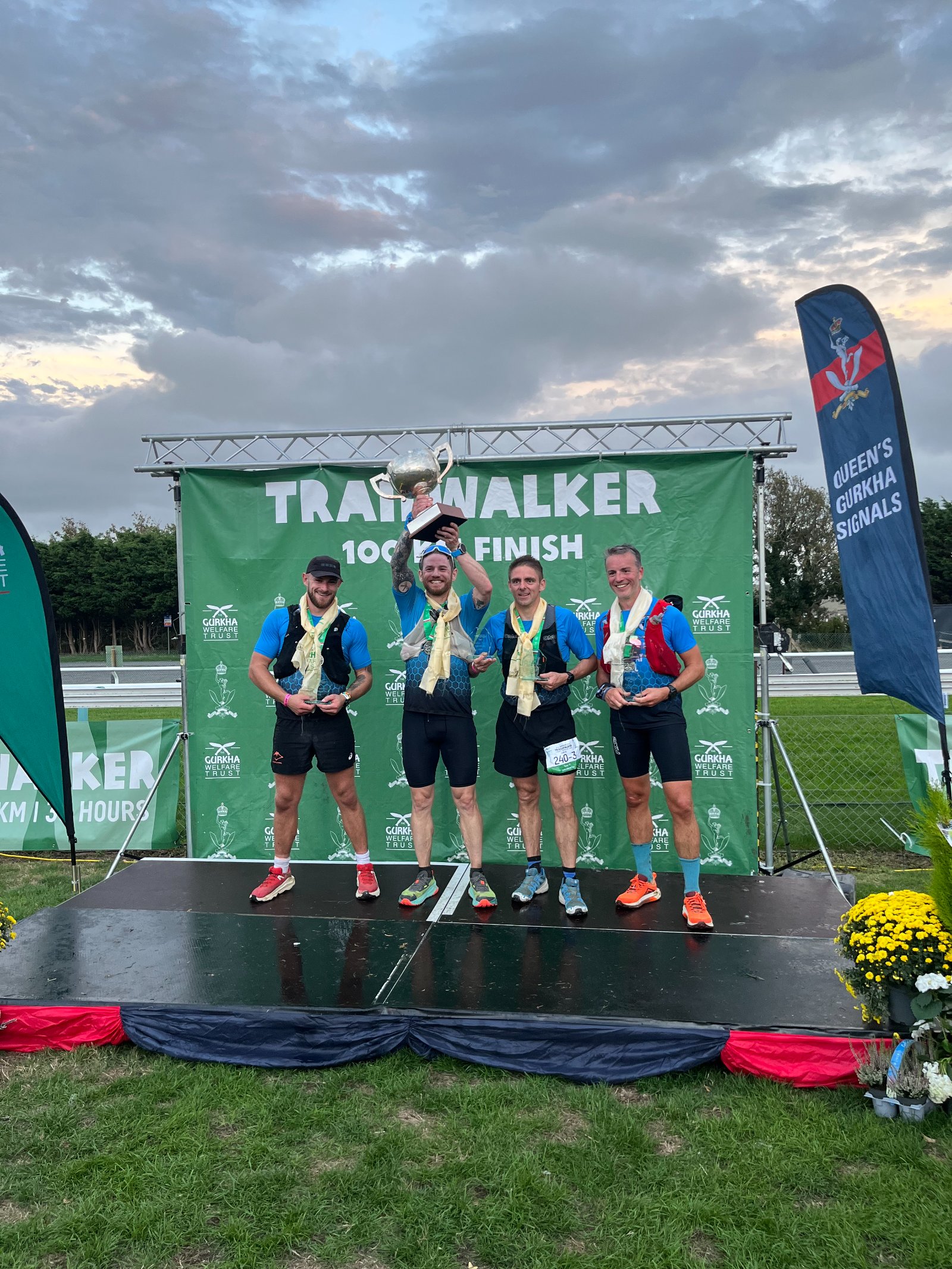
In 2025 we lined up at the Trailwalker 100km with a simple aim: do as well as we could. By the final 20km stretch, team members across the board were struggling and picking up little niggles. We still put in a strong result. We finished around 20 minutes behind first place in the civilian division. Close, but not quite. And that gap sat with me all year.
BLUF: We did not win Trailwalker 2026 on motivation. We won it because the whole team trained to stay durable across 100km, not just to survive it, and durability is a thing you build long before race day.
Why this race matters to me
First, some honesty about the emotion in this, because it shaped everything.
The Trailwalker 100km means the absolute world to me as a former Queen's Gurkha Signals officer. I have a deep affinity with the Gurkha community, and this race sits in my calendar as one of the most important I do. So when we came up short in 2025, it was not just a placing. It was unfinished business.
That being said, I want to be careful here. The story is not "Tom wanted it more". Wanting it more does not carry you over 100km. The mission gave us a reason to train properly. The training is what actually won it.
What went wrong in 2025 (and what it taught us)
The 2025 result was good. We were a team of four getting after something extraordinary, and we held together to the end. But by the final 20km, several of us were breaking down in small ways. Tight calves. A grumbling knee. Stomach issues. The kind of niggles that do not stop you, but slow you significantly.
So, what that means is: we did not lose 20 minutes in one dramatic moment. We lost it in a slow drip, right at the end, when durability ran out.
The key takeaway from that was clear. The limiting factor over an ultra is rarely how fast you can run when fresh. It is whether your body is still working at kilometre 85.
What we changed for 2026
As I coach all the team members, I had control over the training, and they all put in an ultra-marathon preparation block. Not just long runs, although there were plenty of those. A complete build. Here is what that looked like:
- Long running. The non-negotiable foundation for an ultra. Time on feet, teaching the body to keep moving when tired.
- Appropriate intensity. Not everything slow and steady. Some faster work to lift the ceiling, so that ultra pace feels comfortable rather than maximal.
- Strength work. This is the piece most endurance athletes skip, and it is the piece that kept us together.
- Plyometrics. Building tissue that can absorb impact rep after rep, hour after hour.
Why does this matter for you, reading this at home, wondering if any of it applies?
Because there is decent evidence that strength training improves endurance performance and running economy, and helps runners resist fatigue. A 2017 systematic review and meta-analysis in Sports Medicine found strength training improved time-trial performance and economy in trained endurance athletes (Blagrove et al., 2017). And a review in the British Journal of Sports Medicine found that strength and proprioceptive training reduces sports injury rates (Lauersen et al., 2014).
I will be honest about the limits of that: those studies were not run on Trailwalker teams over 100km, so I am not claiming a straight line from the paper to our result. But the principle held up in exactly the way you would hope. The strength training worked. No niggles. No injuries. The whole team stayed physically strong across the distance, and that was the single biggest difference between the two years.
The race itself was not easy
I do not want to make this sound like we trained hard and then floated round.
There were the inevitable highs and lows of ultra running. The distance always finds something. This year, it found me. I picked up stomach issues and could not hold down any solid food. So I switched to liquid carbohydrates and kept the fuel going that way instead.
The key message here: that only worked because I had a fuelling backup and a team around me. When solids stopped, I still had a way to take on energy. If liquid carbs had been a total unknown on the day, that could have ended my race.
Try this for your own events: never test a fuelling strategy for the first time on race day. Practise both solids and liquids in training, so that if one fails, you already know the other works for you.
How a team gets you through
The four of us, myself, the Robs, and Dillon, rallied and pulled each other through the bad patches. We tempered our effort when we had to, kept moving, and backed each other in the low moments. That is the whole point of a team over this distance. On your own, a low patch can spiral. In a team, someone carries you until you can carry yourself again.
And none of it happens without the people who never appear in the result.
Emma and Megan ran our support crew. Anyone who has done a long, crewed event knows the crew is not a footnote. They are the difference between a smooth transition that takes 3 minutes, vs a 10 min break at every check-point. They had food ready, fuel ready, kit sorted, and morale on tap. When my stomach went, that support mattered even more as they rolled out my trusty cup-a soup.
What you can take from this
You do not need to be signing up for a 100km ultra to use any of this. The lessons scale down cleanly to a 10k, a half marathon or a Hyrox.
- Train to be durable, not just to survive. The finish is decided by whether you are still moving well late on. Build the body that lasts.
- Do not skip the strength work. It is the part that keeps you healthy enough to actually train, week after week.
- Rehearse your fuel, including a plan B. Stomachs are unpredictable. Have a backup you have already tested.
- Surround yourself with the right people. Teammates who pull you through, and support that has your back.
We came back stronger, we stayed injury-free, and we won the civilian division. But the thing I am proudest of is not the placing. It is what it says about this group of ordinary people getting after extraordinary things. I am so proud of the team. It was an incredible experience, and it is proof that the boring, consistent, unglamorous work is what shows up when it matters.
Better to be consistently good, than sporadically great. Every time.