
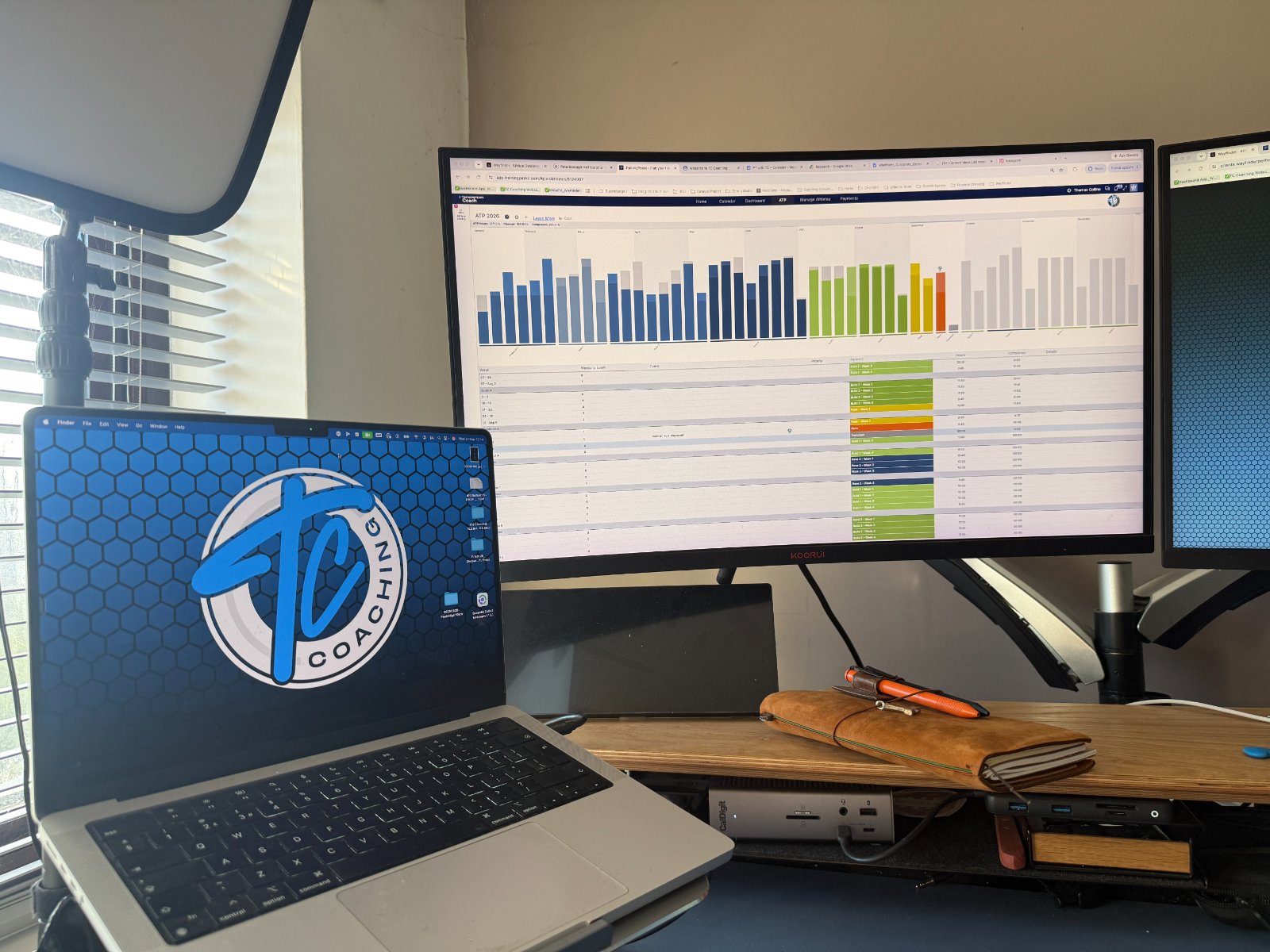
So, firstly… the off-season is not the time to switch off completely, eat everything in sight, and hope you feel fresh in January. That is one version of it, often terribly plagiarised from professional sport. For most of us, it is something more useful: a chance to actually look at the year you just had, and decide what to change.
BLUF: Before you plan next season, review this one in three parts: your consistency, the type of sessions you kept missing, and how your races actually went. Get those three answers and the next plan almost writes itself.
Why the total shutdown does not apply to most of us
I get the premise. The traditional off-season, a proper break from training, comes largely out of elite sport, and it is still championed by some fantastic coaches.
That being said… look at the volume and intensity those athletes put in across a season. It goes far beyond anything most of us are likely to experience. So physiologically, the case for a total, extended break is weaker for the everyday endurance athlete than it sounds.
So, what that means is this: instead of seeing the off-season as a full stop, see it as an opportunity. An opportunity to properly prepare for the rigours of next season, and to fix the things that quietly cost you this one.
The way I do that with the athletes I coach is simple. Once the A-race is done, the thing that mattered most, we sit down and run a full review of the year. Whether they have been with me three months or three years, everyone does it.
Here is the framework. Three parts.
Part one: review your consistency, not your sessions
The first thing has nothing to do with the content of the training itself. It is about when the work actually happened.
So, the key message here is: we look at what days you were most likely to hit your sessions, and what days, as part of a pattern, you tended to miss.
Not one bad week. A pattern. Pull up your training log and look across the whole year.
Here is what to do:
- Look at which days of the week you consistently completed sessions.
- Look at which days you consistently skipped, moved, or half-finished.
- Notice the life reasons behind them (work travel, the school run, back-to-back meetings, tired evenings).
For example: if Monday and Tuesday sessions almost always got done, but Thursday quietly slid week after week, that is not a discipline problem. That is information.
Because rule number one on most of the programmes I write is: get the work done, and shift things about if you need to. That works. But it is not optimal, if we can use that word, because every programme is written with a certain stimulus in mind, a certain order, some days deliberately back to back.
So once we know which days worked and which did not, we can build next season's routine around real life, not around an ideal week that never happens. We craft a programme that is actually more possible to stick to.
The key takeaway: consistency data first. Fix the container before you fill it.
Part two: understand what type of session you kept missing
The second part goes a level deeper. It is not just when you missed, it is what.
Because missing the odd session is normal. But if you look back and the same category keeps falling off, that tells you something specific about how to build next season.
Here is what to look for:
- Long sessions. If the long run or long ride kept slipping, the issue is usually time and logistics, not fitness. That is a scheduling and planning fix.
- Hard or interval sessions. If the tough ones kept vanishing, it can be fatigue, dread, or scheduling them on a day you had nothing left to give.
- Easy sessions. If the easy work kept getting skipped or turned into something harder, that is often an intent problem. Easy needs to be easy for a reason.
- Strength. Almost always the first thing to go when life gets busy. If it disappeared by March, we need to make it smaller and more protected, not more ambitious.
So, what that means is we do not just replace the missing sessions. We ask why that type kept losing. A long ride that never fits on a Saturday morning might belong somewhere else entirely. A hard session that you dreaded might be sitting on the wrong day.
This is where a lot of progress quietly lives. Not in adding more, but in protecting the sessions that carry the most value and kept getting dropped.
Part three: review how your races actually went
Now, and only now, we look at the racing itself. I put it third on purpose, because performance sits on top of consistency. If parts one and two were shaky, the race result is often just a symptom.
So, firstly, look at your A-race honestly, and any key races along the way. Not just the finish time. The whole thing.
Try this, walk through each race in three chunks:
- The build. Did you arrive rested and prepared, or dragging fatigue and doubt? Often the answer traces straight back to your consistency review.
- The execution. Did you pace it to plan? Where did it go well, and where did it come apart? Was fuelling right? Did the wheels come off physically, or did the head go first?
- The outcome versus intent. What did you actually want from this race, and did the day reflect that? Be honest about whether the goal was even realistic given the training that went in.
Write it down. Memory is generous and unreliable, and you will want the honest version when you plan.
The key here is to separate the controllables from the noise. A flat day because you were undercooked is a training problem. A blown-up back half because you went out too hard is a pacing and discipline problem. A stomach that ended your day, and it does happen, might be a fuelling problem. Each one points to a different fix.
Now, and only now, decide what to change
Here is why the order matters. Most people start planning next season by picking a bigger goal or a shinier plan. They skip straight to the fun part.
But if you do the review properly, the changes tend to reveal themselves:
- Part one tells you the shape of a week you can actually keep.
- Part two tells you which sessions to protect and where to put them.
- Part three tells you what to sharpen in how you race.
So, what that means is you are not guessing. You are building next season on evidence from the last one, rather than on optimism.
And remember, you cannot get this right from word go. The first version of any plan is a best guess. The review is how a good guess becomes a better one.
Because, as ever, better to be consistently good than sporadically great. The whole point of this exercise is to make consistency easier next year than it was this year.
If you want a hand working through your own three-part review, or you are staring at a year of data and not sure what it is telling you, don't sit on it, let me know.