
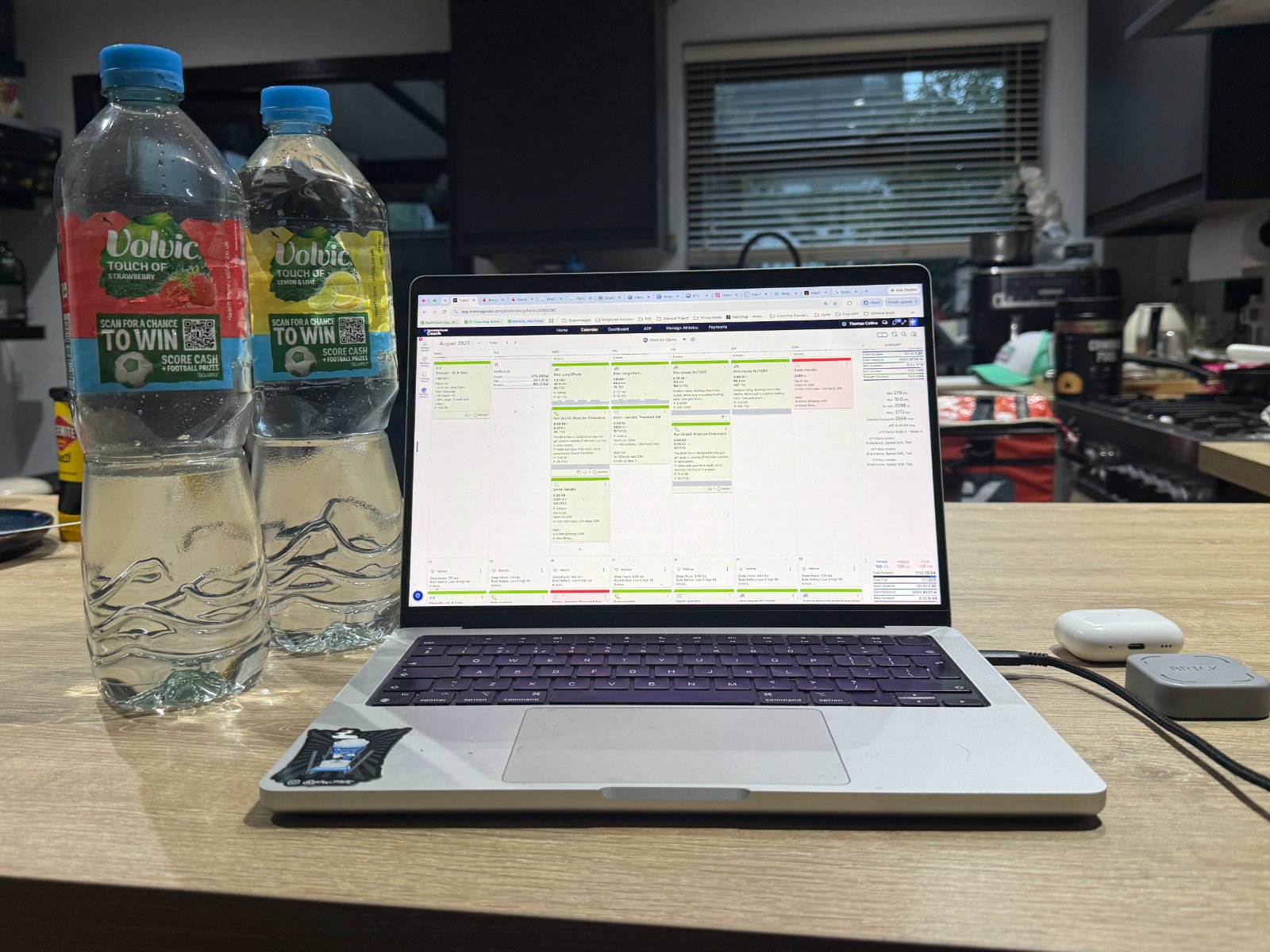
So, firstly… the vast majority of people I speak to have no real idea whether they are drinking enough water. They carry a bottle around, they top it up through the day, and they feel like they are on top of it. But feeling like it and knowing it are two very different things.
BLUF: Hydration is rarely a knowledge problem. It is a measurement problem. Fix the measurement and the habit takes care of itself.
Carrying a bottle does not mean you are hydrated
Here is the thing… if you carry a water bottle and refill it a few times, you get the feeling of drinking plenty. That feeling is convincing. It is also useless as evidence.
Unless you are tracking it (an app, a note on your phone, tally marks on the fridge, whatever), you genuinely do not know how much you have drunk. You are estimating. And most people, when they estimate, land somewhere well short.
That being said, I am not having a go. Intuitively, everyone knows hydration matters. The gap is not caring. The gap is that most people who think they are hydrated are actually a bit dehydrated, and they have no way of telling.
The measurement gap
When you refill a bottle throughout the day, you lose count. Did you fill it three times or four? Was it full each time or half full? Did you finish the last one? Nobody knows. So you default to a vibe.
The key message here is: if you cannot measure it, you are relying on a feeling. And feelings drift.
So, what that means is we need a system where the answer is obvious. Not clever. Not high-tech. Just obvious.
The two-bottle standard
I like to make things as simple as possible, so here is what I give people.
Take 3 litres as a simple daily baseline. Get two 1.5 litre bottles. That is your target, split in two.
Here's what to do:
- At the end of every day, fill both bottles right up.
- You then start the next day with two full bottles ready to go.
- You carry them with you and drink them across the day.
- When you come to refill in the evening, you can see exactly where you landed.
That is the whole thing. Two bottles. Three litres. No guesswork.
Why it works
The magic is that the result becomes binary. At the end of the day you either drank your two bottles or you did not. There is no fuzzy middle, no story you can tell yourself. The evidence is sitting there on the side.
And because you filled them the night before, the decision is already made. You are not standing at the tap in the morning deciding how much to aim for. The standard is prepared and visible before the day even starts.
That is the bit most people miss. Consistency gets easier when the behaviour is simple, measurable, and set up in advance. You remove the daily negotiation with yourself.
Use the leftovers as feedback
So, what if you get to bedtime and there is still water left in a bottle? Good. That is not a failure, it is information.
The task is to drink what is left there and then, before you go to bed, and then refill for tomorrow.
Yes, that might mean drinking water close to bedtime. Yes, that might mean getting up in the night for the toilet. And honestly? That is only likely to spur you on to drink earlier the next day. The system corrects itself. You do not need willpower, you need feedback, and the leftover water is the feedback.
Then you just repeat it. Fill at night, drink through the day, review, refill. Over and over.
A word on the number
I can see the objection coming, so let me be straight with you. The 3 litre target is my simple baseline, not a universal law handed down by the ancient god of hydration...
Your actual fluid needs vary. Body size matters. Climate matters. How much you sweat matters (and if you train hard, you will lose more). Diet matters too, because a chunk of your fluid comes from food, and other drinks count as well.
Now... The NHS suggests aiming for around 6 to 8 cups or glasses of fluid a day for most adults, which is a lower figure, and they note this can include drinks other than water (NHS: Water, drinks and hydration).
But, instead of getting hung up on the figure the NHS gives.... I mean, let's not forget that the NHS recommends that adults (aged 19-64) aim for 150 minutes of moderate activity (like brisk walking or cycling) or 75 minutes of vigorous activity every week.... which is a pretty low bar!
So do not get hung up on hitting exactly 3 litres to the millilitre. The point of the two-bottle standard is not the number. The point is that you finally know what you drank instead of guessing. Once you can see it, you can adjust it up or down to suit you.
If you are training in the heat, or you are a heavy sweater, or you have got a long session on, you will likely need more, and you will need to think about electrolytes too, not just plain water. But that is a refinement. Get the baseline visible first.
Why bother at all
Because hydration touches almost everything. Energy through the day. Brain function and concentration. Recovery from training. It is quietly involved in all of it.
And it is possibly the most powerful thing you can put in place immediately. It costs almost nothing. It needs no equipment beyond two bottles you probably already own. There is no learning curve.
Most of the health stuff people ask me about takes weeks or months to show up. This one you can start tonight, and you will know by tomorrow evening whether you did it.
The bigger principle
This whole thing is really a small example of how I think about behaviour change.
People do not usually fail at habits because they lack information. They fail because the behaviour is vague, the target is invisible, and every day starts with a fresh decision to make. Remove those three problems and consistency gets a lot easier.
So we make it simple. We make it measurable. And we prepare it in advance.
Better to be consistently good than sporadically great, and two full bottles on the side is about as consistent and boring and reliable as it gets. That is a compliment, by the way.
Try this
Tonight, before bed, fill two 1.5 litre bottles. Leave them where you will see them in the morning. Drink them across tomorrow. In the evening, have a look and be honest about where you landed.
Do that for a week and you will know more about your real intake than you have ever known from guessing.
If you have got any questions, queries or concerns about fitting the basics around your training, don't sit on them, let me know.