
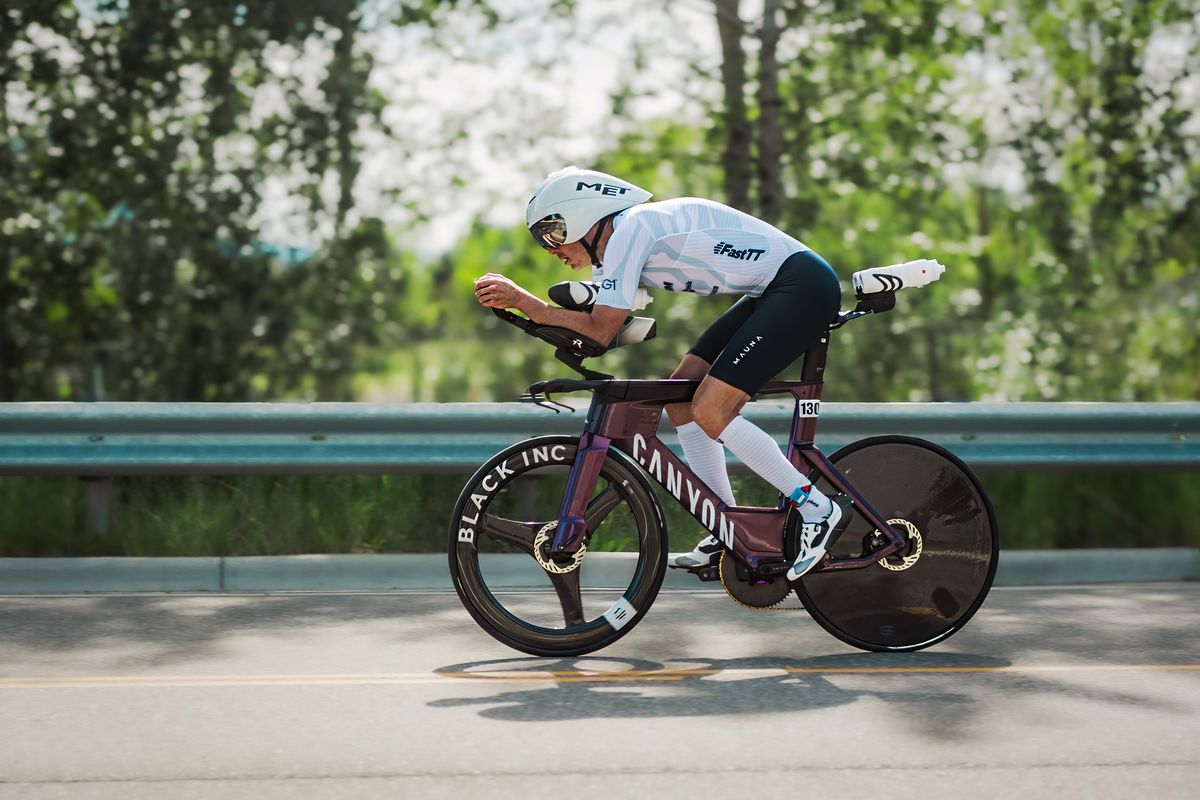
"How hard should I ride?" is the question, and the honest answer is: easier than you will want to. Here is the pattern I see more than any other in a first 70.3.
Athlete comes out of the water feeling good. Gets on the bike. Feels brilliant. Rides brilliantly. Then walks a chunk of the run wondering what happened.
Nothing went wrong on the run. It went wrong in the first half hour on the bike.
BLUF: for most age-group athletes, the 70.3 bike should sit around 72 to 78% of FTP, ridden steadily. That feels too easy early. That is the point.
Why the first 30 minutes decide your day
You come out of the swim with adrenaline up, having been overtaken by people you fancy chasing, on fresh legs. Everything conspires to make you ride too hard while it feels effortless.
The cost is deferred, which is exactly what makes it so easy to do. As one coaching breakdown puts it, every watt you overspend in the first 30 minutes is a minute you lose in the final 10km of the run, and usually more.
So, what that means is: the bike is not where you make your race. It is where you protect it.
The numbers
General 70.3 guidance sits at 75 to 82% of FTP, with age-groupers specifically advised toward 72 to 78%, and stronger cyclists riding nearer the top of that range.
Two practical points on top of that:
- Intensity above about 0.80 is usually a bike personal best followed by a run blow-up. Tempting, and rarely worth it.
- Steadiness matters as much as the number. Variability index (normalised power divided by average power) should stay near 1.05 on a flat course. A VI of 1.10 means you are surging and coasting, which burns considerably more glycogen for the same average power.
If you do not know your FTP yet, our FTP Calculator works it out from a single 20-minute test and gives you the full set of training zones.
If you have no power meter
Ok, no worries… plenty of people race well without one. Ride to effort instead.
Target RPE 5 to 6 out of 10 for the first hour. Conversational, controlled, slightly frustrating. If you cannot speak in short sentences, you are riding your run away.
Our RPE guide explains how the 1 to 10 scale maps onto power and pace, and why effort is often the more honest guide, especially on a hot or windy day.
Hills, wind and the real course
A flat course and a hilly one need different plans, and this is where generic advice falls down.
Here's what to do:
- On climbs, let power rise a little, not a lot. Maybe 10 to 15% above target on the steeper pitches, then settle straight back. Do not attack them.
- Do not coast the descents. Free speed is the cheapest speed in the race. Keep pedalling lightly.
- Into a headwind, hold effort, not speed. Chasing a number on the computer into wind is how people cook themselves.
- With a tailwind, stay aero and take the gift. Do not add power just because it feels good.
- Ride the second half at or below the first half. If you finish the bike thinking you had more, you have paced it correctly.
Fuelling is part of pacing
These two are the same conversation. Riding at a sensible intensity is what lets your gut absorb food at all. Ride too hard and you cannot eat, and once you cannot eat, the run is already gone.
Take the bulk of your carbohydrate on the bike, in the range covered in our piece on carbs per hour. Steady effort and steady fuelling protect each other.
Know your course before you ride it
Try this: open your race in our Event Strategy section. Every guide is built on the official course elevation data, so the pacing calculator models your ride against the real climbs and gives you a predicted bike split, a run split and a finish range.
For example: 900m of climbing across 90km asks for a very different plan than 300m on an exposed, windy island loop. Knowing which one you have entered is half the job.
The bottom line
Ride the first half hour like you have somewhere better to be later, because you do. Aim for 72 to 78% of FTP, or RPE 5 to 6, keep it steady, eat properly, and let the people who sprint past you at 20km come back to you at 15km of the run.
The key takeaway is: the bike leg is an investment in the run. Spend it carefully.
If you want your pacing plan built around your numbers and your course, don't sit on it, let me know.